The Myth of the Moral Majority
Books: Here's the church. Here's the steeple. Open the doors and—hey, where did all the evangelicals go?
|
|
Listen to the interview with Debra Dickerson
this february, the Pew Forum on Religion & Public Life released the most comprehensive of its surveys of the "religious landscape" of the United States. Front and center was the finding that 26 percent of American adults—around 54 million—are evangelical Protestants. The idea that 1 in every 4 of us thumps a Bible only confirmed what many had assumed to be gospel since 2000, when evangelical voters were credited with winning the White House for George W. Bush and the media began its grand genuflections toward a resurgent fundamentalism, casting evangelicals (and more broadly, "values voters") as a politicized wedge that politicians ignored at their peril.
And who could blame them? Not only are evangelicals supposedly our biggest religious voting bloc, but Pew reports that nearly 80 percent of Americans are Christian, and 40 percent attend church weekly according to Gallup Polls. But what if those numbers—and everything we've assumed they tell us about the power of the religious right—are wildly wrong?
Take that 40 percent church attendance stat. Looking around her half-empty Southern Baptist church outside Dallas, Christine Wicker had her doubts. Wicker, a veteran Texas newspaper reporter, was born again when she was nine but drifted away from her evangelical roots in adulthood. A few years ago, she returned to the Southern Baptist Church to both renew her faith and write The Fall of the Evangelical Nation, an insider's look at evangelicals' power, wading in where secular journalists feared to tread. When she started looking into the numbers on church attendance, she found that researchers could vouch for only 18 percent of Americans being regular churchgoers—less than half the accepted figure. That led her to wonder about the already widely reported claim that 25 percent of Americans are evangelicals; could the real number also be less than half that?
In size, only the Catholic Church dwarfs the Southern Baptist Church, the biggest evangelical denomination and by far the most organized and fastidious of the Protestant record keepers. But Wicker discovered that the numbers the Southern Baptist Convention (sbc) releases for public consumption tell a much different story than the ones it uses internally. The organization claims 16 million members, but as one reverend cracks, "the fbi couldn't find half of [them] if they had to." A 2006 sbc report states that only 11 million of its members live in the same area as their home church anymore; that number includes those who've been double- or even triple-counted elsewhere. It also includes perennial no-shows and those who attend services at "bedside Baptist" (they sleep in on Sunday but show up for Easter and Christmas). And that's not to mention those who've lost their religion or converted to another faith. If their names were ever on "the roll" at a Baptist church, they're probably inscribed there for life.
With more digging, Wicker came across a 2007 sbc report that found only 5.4 million adults attended services regularly enough to be considered church members. Further complicating matters, many of those who regularly filled the pews weren't official members, and, most significantly, 1 in 8 wasn't saved or born again. Factoring all this in, Wicker calculated that there are fewer than 4 million devoted Southern Baptists. Her math seems to be backed up by collection-plate totals: If the church truly has 16 million members, then they contributed a miserly $3.50 each to a nationwide fundraising campaign last year.
And it's not just the Southern Baptists who appear to be playing number games. The National Association of Evangelicals, an umbrella group that does not include the sbc, claimed 30 million members on its website. When Wicker contacted the association for comment, the figure changed to 4.5 million. No one there could—or would—explain the sudden 85 percent drop in believers. (However, the group's website currently describes its lobbying arm as the voice of "30 million Americans united under a common banner.")
The emperor's-new-clothes flimsiness of these widely accepted exaggerated numbers says much about the cold calculation of far-right religious leaders. Moral Majority and Focus on the Family have happily staked their clout on coreligionists who never knew they were being counted—often twice or three times—among the faithful for political ends. "The idea that evangelicals are taking over America is one of the greatest publicity scams in history," Wicker concludes, "a perfect coup accomplished by savvy politicos and religious leaders, who understand media weaknesses and exploit them brilliantly."
Though she doesn't delve into those weaknesses, Wicker's findings speak volumes about the limitations of a Fourth Estate that accepted and uncritically deferred to the power of the religious right. Having been handed a ready-made story line by the thou-shalt-not brigades, the media became transfixed by a phenomenon they couldn't fully fathom but felt bound to report on. Those unexamined numbers and claims of followers in theological lockstep launched a thousand cover stories and columns—rarely prompting questions about what a term as broad as "evangelical" really meant on the ground. Whether they viewed it as a new political reality, a megatrend, or a bogeyman, the media embraced the idea of a reenergized, monolithic Christianity and faithfully chronicled something that didn't exist.
Part of the problem is that the national-level journalists who control the discourse tend not to be, nor have they ever been, committed religionists as adults. Newsrooms are determinedly secular, and self-consciously so. Afraid of being tagged as godless liberals, most journalists would never dream of calling BS on believers. Which may explain why Wicker's book could only have been written by a born-and-bred Baptist.
Innumeracy and gutlessness aside, why did we never ask ourselves if the label "evangelical" tells us anything more than the yarmulke or the head scarf on the person next to us at Starbucks? To assume that evangelicals overwhelmingly oppose divorce, abortion, and gay rights; that they believe in school prayer and intelligent design; and that they're overwhelmingly politicized is a gross oversimplification that evangelicals themselves ought to find disquieting. As Wicker suggests, perhaps one's answer to the drone who interrupts dinner to ask your "religious preference" is more reflex than exit poll.
Wicker finds that many of the most active believers belong to both a small "home" church and a megachurch where they "vacation." And as the most recent Pew study shows, 44 percent of Americans say they have switched their religious affiliation or moved between periods of declaring a faith and religious free agency. Religious identity, it turns out, is as fluid as any other.
It is with believable regret that Wicker pulls the threadbare rug out from under the "powerful" Christian far right. "Just as I had finished convincing myself that the evangelical church was smarter and had more to offer than ever—I'm still convinced of that—I was hit with the growing suspicion that the entire faith might be sinking fast," she writes.
She's probably right that old-school fundamentalism is going the way of the dinosaurs. The Southern Baptist Church's much-publicized effort to baptize a million souls in 2006 was a dismal failure; only one-third of that number "bathed in Jordan's water." According to George Barna, an independent evangelical researcher who tracks spiritual trends, 20 million born-again Christians are moving beyond formal churchgoing, meeting in small groups, often in each other's homes. He predicts that by 2025, local churches will have lost half of their current "market share." No doubt many of those leaving the church find fire and brimstone as anathema as any liberal but still believe that there is a living God who loves them.
If there are as few evangelicals as Wicker claims, can we ink-stained wretches go back to ignoring them? Not so fast. Religion will always be of more cultural significance than the mere number of its adherents, especially as the United States becomes ever more diverse and other religious traditions clamor to be heard. We will have to go on respecting Christianity and deferring to its oversize voice in public affairs if only because all those bedside Baptists might just stop sleeping in on Sunday if the beliefs they rarely dust off suddenly come under attack.
Still, The Fall of the Evangelical Nation makes plain that the media must be doggedly skeptical whenever faith-based constituencies claim their place in the public square. Maybe all us godless liberal journalists need to get religion about confronting America's most sacred cow.
Debra J. Dickerson, a self-described "millionth generation Southern Baptist," blogs at motherjones.com.
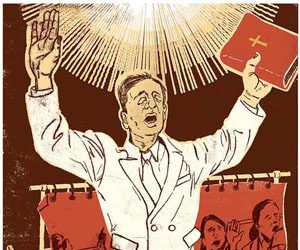
Illustration: Edel Rodriguez

Excellent article...I've put it on my list to buy. Keep up the good work Christine (and Debra) :)
Sounds like child abuse to me.
It's pretty obvious that the reason for the exaggerated numbers is to impose the Evangelical agenda on non-believers. I consider that to be downright un-Christian.
Great article! I'll have to take a look at the book.
I go to a moderate church and although I'm not an every Sunday attender, I go about 30 times a year. What I find there is a lot of varied ideas about things political. If bumper stickers in the church parking lot are any indication, there are as many democrats as republicans.
I think the reason that newsrooms have believed otherwise has to do not so much with who we are, as who they all. When I tell a Catholic or a Jew that I'm a Baptist they are as shocked as if I admitted to being a wild-eyed snake handler. Sterotypes are sometimes helpful, but never as dead-on as you think they are.
Also, Evangelicals are not static. Minds change every day. I think that comes with the territory of "work out your own salvation with fear and trembling". (Phil 2:12)
I'm putting my current HOPE in Obama for helping us speak with a voice that isn't Falwell or Hagee.
This ideal has been compartmentalized and radicalized to exclude anything but abortion and contraception. Catholics in most of the world believe in some form, mitigated or not, believe in social justice. True religious belief in Christ's or Allah's or Buddha's teachings really don't sit well with Adam Smith, while the disciples of the religion of the benevolent hand of markets is atheism, purely and simply.
When Catholic opinion is presented by quoting the views of the Catholic lunatic fringe, it does nobody any good.
Catholic martyrs that espoused liberation theology are real Catholics, and thanks to idealogues like Reagan, many of them are martyrs. We aren't fighting Communism anymore (and lord know it's a shame a fight against world'wide communism was ever made into a fight of God vs. the Devil.
Injecting this sort of crap into US elections, and acting like you represent 100s of Millions that fundametally disagree with you is obtuse, incredibly dishonest, and horribly illuminating of character, an idictment of your own Christianity, and proof of pure, eillingness to jerk media around.
my thinking but I am honest about it but
this political partnership with religion
is wrong.
Quite frankly, anyone who has to TELL me they are a Christian, ISN'T. Actions speak louder than words in that department so all the screaming from the pulpits and proclaiming what you are won't convince me.
Thank you Debra for taking on an issue that I have always suspected was a fraud - and proving it.
Now if we can just get SEPARATION again! Religion can inform public life - but it has no business running it, or making demands to adhere to its various narrow tenets.
The secular pushback needs to occur, so that the so called "religious moderates" can realize that their best interests are in secular society, not in one steeped in faith. No more bending over backwards for faith, if they can pound the pulpit and push an agenda, we can call bull on it.
i see no difference between an atheist and a religous person they both think they know.
very dangerous assumptions.
bible is full of ignorance but so is darwinism both modes of thought have created great suffering in the world.
capitalism is based on survival of the fittest.
capitalism must self destruct. seeing it happen now.
thank you reagan you sped up the process of economic self destruction and the repubs dont have a clue. in fact they want more of it.
Who is so petulantly arrogant as to believe they could ruin a real god's day anyway? Such hubris!
Now take responsibility and act like the eternal spiritual being that you are. Everyone is god; there's nothing else to be. And if you don't believe that, it doesn't matter!
I'm an Omnian myself.
The Turtle Moves!
exaggerating the numbers serves a few purposes - first because it gives them political clout and respectability. it's much harder to dismiss a church that claims millions of members as a cultish fringe group, even if it was founded by a pedophile scam artist. fear of offending "millions" of mormons means that the press never shines a light on their explicitly white supremacist doctrine or the church's claims that native americans are descended from renegade Israelites (something that has already been disproved by DNA evidence).
secondly, and obviously, wildly exagerated membership numbers give them wildly exaggerated lobbying power and political clout in washington where they spend obscene amounts of money to support anti-abortion and anti-gay politicians.
lastly, having a membership count that constantly rises due to a massive ongoing missionary effort and a refusal to remove people who leave the church (in the Philippines, for instance, 80%+ of new mormons leave the church after less then a year) means that the church's "prophet" can claim to the members that they are being successful at spreading gods word, and they should continue giving 10% of their income to the church.
one last point - and this applies to all of the godheads, not just Mormons - if we can't trust these people to even be honest about their own numbers, isn't that an indicator they aren't really credible authorities on moral issues? If they habitually lie about even trivial things like this, the media has no business affording them any space at all in public debates. they simply aren't credible. you don't invite other scammers and con men onto the evening news and let them talk up their con games, why do we let this happen when the con involves an all-powerful imaginary friend?
Why do our leaders need to subscribe to a belief system that is predicated on the notion that there once was a man, who is god, who was tortured to death, for the purported benefit of all, because, initially, someone at an apple?
The message of Evangelicals is one of hope, patience, and love. If you disagree that's perfectly fine, but that belief is usually based on people who have been observed to be flawed yet still associated themselves with Christianity. Christianity recognizes all people's fallibility. You can go ahead and demonize the faith here and you can demonize me, as it is all so easy to do to a faceless group of people. I'll readily admit that I am no Jesus Christ and I have my own faults. But I strive to adhere to the teachings of the Bible. Maybe you judge Christianity by the actions of a few or maybe all the Christians you’ve ever known. The Bible says that by their fruits will you know them. If that’s the case, maybe you’ve never really known a Christian, or maybe you did but they never made a point of telling you. The idea of there being hypocrites, or in other words, imperfect people attending church should really be of no surprise unless people are naturally born good, which is a less distasteful concept to accept.
Like the article, it prooves that "offical" statistics about belief are often misleading, if not down-right a lie. I was raised Roman-Catholic, & am now an Agnostic.
I can see the appeal of religion; it takes away the burden of having to think for yourself & take responsiblity for your own actions.
I believe that it is highly unlikely that there is a god or gods.
Religion is simply a means by which the rich & powerful accumulate ever more wealth & power (look at our current President).
Anyone who looks at these "holy books" objectivly can see the lies, illogic, & contridictions in them.
According to the Koran (in which, of all the women mentioned, only Mary, the mother of Jesus is even mentioned by name), it is indecent for a woman to go with her head/face uncovered, but not a man, and any man who dies in the act of killing another person automattically goes to heaven & gets 40 virgin sex slaves.
According to the torrah (Old Testament), all male infants should be circumcised, eating pork, shellfish & many other foods is an "abomination", and an "adulterous woman" should be stoned to death (but nothing is mentioned about anything being wrong with a man commiting adultry), and as for the New Testiment, aside from its dubious orrigions in the 5th century AD, it also is filled with contridictions. Ex: in one instance Jesus says in it "all things are possible through god", & in another instance, when asked why he can't heal a sick person, he said he couldn't heal people when sourounded by so many "disbelievers".
Then of course there is the fact that the different books of the bible don't even agree on where he was born.
And "Wives obey your husbands, and slaves obey your masters." are not the words of a just and loving god.
And if you believe the idea of all of humanity being decended from only 2 people, then you have to believe that humanity got started through incest.
As for the story of the "Annunciation", the baisic gist of it went like this:
Angel Gabriel adressing Mary: "Congradulations! You've been chosen to be God's brood mare!
And if you don't like it, TOUGH, because you're already pregnant!"
Mary: "...."
So much for the idea of "free will".
There is not a shred of evidence to support the idea of the existance of "god" or any other supernatural phenominon. Belief in god is baised entirely on faith. Like belief in Santa Claus.
Have they no shame?
When it comes time to defend their own values against misrepresentation by the right, the religionistas are on their own to get the news out, and therefore at a disadvantage.
For the right, it's a perfect situation: Claim the support of the churches for their policies (note that the churches themselves are never heard from -- just rightists TELLing us what the churches think and want), and just don't say anything at all related to values, when the Larry Craigs and Mark Foleys crop up.
The implication, by those currently in the way of the uprising, is that Evangelicals are behind them 110% -- even when they are a bit (shall we say?) ethically challenged.
If I were one of these misrepresented Evangelicals, I think I'd get on the phone to the press, to clear my smeared name. Then I'd go and donate on Obama's website, to get the bastards out of office once and for all.