MOTHER JONES BY E-MAIL

Original Intent

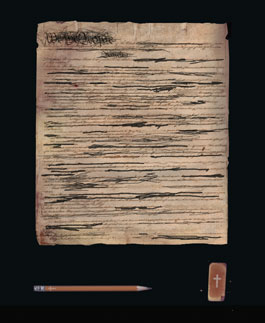
News: Revisionist rhetoric notwithstanding, the founders left God out of the Constitution–and it wasn't an oversight.

December 2005 Issue


TOOLS

EmailE-mail article
PrintPrint article


BACKTALK

E-mail the editor


Google


RELATED ARTICLES

When the Supreme Court, in one of its most important decisions of 2005, ordered two Kentucky counties to dismantle courthouse displays of the Ten Commandments, Justice Antonin Scalia declared that the Court majority was wrong because the nation's historical practices clearly indicate that the Constitution permits "disregard of polytheists and believers in unconcerned deities, just as it permits the disregard of devout atheists."

The Constitution permits no such thing: It has nothing to say about God, gods, or any form of belief or nonbelief—apart from its absolute prohibition, in Article 6, against any religious test for public office and the First Amendment's familiar declaration that "Congress shall make no law respecting an establishment of religion, or prohibiting the free exercise thereof." From reading Scalia, a Martian (or polytheist) might infer that the establishment clause actually concludes with the phrase "free exercise thereof—as long as the faithful worship one God whose eye is on the sparrow." The justice's impassioned dissent in McCreary County v. the American Civil Liberties Union of Kentucky is a revealing portrait of the historical revisionism at the heart of the Christian conservative campaign to convince Americans that the separation of church and state is nothing more than a lie of the secularist left.

For the 21st-century apostles of religious correctness, the godless Constitution—how could those framers have forgotten the most important three-letter word in the dictionary?—poses a formidable problem requiring the creation of tortuous historical fictions that include both subtle prevarication and bald-faced lies.

Religious reactionaries of the 18th century, by contrast, were honest in their attacks on the secularism of the new Constitution. One North Carolina minister observed with forthright disgust, during his state's ratification debate, that the abolition of religious tests for officeholders amounted to nothing less than "an invitation for Jews and pagans of every kind to come among us." The Reverend John M. Mason, a fire-breathing New York minister, declared the absence of God in the Constitution "an omission which no pretext whatever can palliate" and warned that Americans would "have every reason to tremble, lest the Governor of the universe, who will not be treated with indignity by a people more than by individuals, overturn from its foundation the fabric we have been rearing, and crush us to atoms in the wreck."

The marvel of America's founders, even though nearly all of the new nation's citizens were not only Christian but Protestant, was that they possessed the foresight to avoid establishing a Christian or religious government and instead chose to create the first secular government in the world. That the new Constitution failed to acknowledge God's power and instead ceded governmental authority to "We the People…in order to form a more perfect Union" was a break not only with historically distant European precedents but with recent American precedents, most notably the 1781 Articles of Confederation, which did pay homage to "the Great Governor of the World," and the Declaration of Independence, with its majestic statement that "all men…are endowed by their Creator with certain unalienable rights." It is worth noting here that the Declaration was a bold and impassioned proclamation of liberty, while the Constitution was a blueprint for a real government, with all the caution about practical consequences (such as divisive squabbles about the precise nature of divine authority over earthly affairs) required of any blueprint.

Eighteenth-century theological conservatives lost the battle over the Constitution, and the pill remains equally bitter to their spiritual descendants. Every time I write an article mentioning the constitutional omission of God, I receive hundreds of identical emails calling me a liar (sometimes a godless liar), because the document is unmistakably dated "in the Year of our Lord one thousand seven hundred and Eighty seven." That the religious right should fall back on a once-common manner of dating important papers—as unrevealing of religious intent as the use of B.C. and A.D.—demonstrates just how seriously it takes the enterprise of controlling the past in order to control the future.

The revisionist script goes something like this: The founders were devout men who based their new government on Christian teaching (the religiously correct invariably use the term "Judeo-Christian"); they were unconcerned about religious interference with government and cared only about government interference with religion; and, last but not least, there was no tension between secularism and religion in the nation's halcyon early decades, because everyone accepted God as the source of civic authority.

The first part of the script—the so-called devoutness of the founders— is least relevant to the current debate over religion in government. John Adams, Benjamin Franklin, Thomas Jefferson, and James Madison, to name only a few, were prolific writers who contradicted themselves (and one another) almost as frequently as did the authors of the Bible. They certainly believed in some form of God or Providence, as Enlightenment rationalists preferred to call the deity, but that is all we can conclude with reasonable certainty. Jefferson's political opponents in the early 1800s were as mistaken to call him an atheist as his conservative modern rebaptizers are to claim him as a committed Christian. (For one thing, Jefferson emphatically rejected the idea that Jesus was divine and instead regarded him as a great but wholly human teacher of morality.) Adams' critics and admirers, then and now, have been equally misguided in their attempts to portray him as a man of orthodox faith.

What did distinguish the most important revolutionary leaders was a particularly adaptable combination of political and religious beliefs that included strong hostility toward all ecclesiastical hierarchies (the original 17th-century meaning of the lovely word "freethought"); the Enlightenment conviction that if God existed, he expected humans to rely on their own reason to conduct earthly affairs; and the assignment of faith to the sphere of private conscience rather than public duty. These convictions carried the day when the former revolutionaries gathered in Philadelphia to write the Constitution.

Regardless of the framers' private beliefs about God, it is more important to look at their public actions in crafting the legal foundation for the new republic. (One might, with less pride, make the same observation about the founders' attitudes toward slavery; whatever they "truly" believed, what matters is that they signed off on a formula counting a slave as three-fifths of a man.) And here the right-wing script goes awry, for it cannot explain why, if the founders intended to base the government on Christianity or monotheism, they failed to spell out their intentions in the Constitution itself. There was certainly ample precedent for doing so, not only in the Articles of Confederation but in nearly every state constitution.

When the Constitutional Convention opened in 1787, with George Washington as its president, legally entrenched privileges for Protestant Christianity were the rule. The Massachusetts Constitution extended equal protection of the law, and the right to hold office, only to Protestant Christians (restrictions that infuriated Adams, the state's favorite son). New York granted political equality to Jews but not to Roman Catholics. Maryland, the home state of the only Catholic signer of the Declaration of Independence, gave full civic rights to Protestants and Catholics but not to Jews, freethinkers, and deists. In Delaware, officeholders had to attest to their belief in the Holy Trinity. Those were the good old days.

Thanks to the strong influence of Jefferson and Madison, Virginia stood alone among the states in guaranteeing complete civic equality and religious freedom to all citizens. In 1786, Virginians rejected a proposal by Patrick Henry to provide public financing for the teaching of Christianity in schools and instead passed an Act for Establishing Religious Freedom, which ruled out tax support for religious instruction and religious tests for public office. Significantly, the new law was supported by a coalition of evangelicals, who—as a minority in a state dominated by Episcopalians—feared government interference with religion, and freethinking Enlightenment rationalists, who feared religious interference with government.

The influence of Virginia's law, enacted less than a year before the writing of the federal Constitution, cannot be overstated. The delegates in Philadelphia could have looked for guidance to a crazy quilt of conflicting state laws, rooted in religious prejudice and incestuous Old World church-state entanglements. Instead they chose the Virginia model, which, as Jefferson proudly stated in his autobiography, "meant to comprehend, within the mantle of its protection, the Jew and the Gentile, the Christian and the Mahometan, the Hindoo, and Infidel of every denomination."

In the McCreary case, Scalia objects to Justice John Paul Stevens' citation of Madison's Memorial and Remonstrance, an impassioned polemic—condemning both religious meddling with government and government meddling with religion—that turned the tide in favor of Virginia's separation of church and state. Scalia disingenuously dismisses the reference because Memorial was written before the federal Constitution—as if Virginia's recent experience had nothing whatever to do with the deliberations of the framers in Philadelphia.

Confronted with the Constitution's silence on divine authority, revisionists repeatedly fall back on the specious argument that since everyone took God's omnipotence for granted in the 18th century, there was no need for the framers to make a special point of mentioning the deity. If that were true, there would have been no bitter debates in the states about the nonreligious language of the Constitution. Moreover, this line of reasoning is self-contradictory, coming as it does from a political/religious lobby that backs the appointment of "originalist" judges—those who insist that the Constitution can only mean exactly what it said at the time it was written. It is ludicrous to suggest that men as precise in their use of words as Adams and Madison would, perhaps in their haste to get home to their wives, have simply forgotten to mention God.

Equally ludicrous is the notion that there was no tension between religion and secularism before federal courts, in the 20th century, began to apply the guarantees of the Bill of Rights to states. The balancing act between secularism and religion, as old as the republic, originated as a creative tension—in contrast to the destructive power struggle that has developed in recent years. For several decades after the Revolution, many Americans saw no conflict between devout personal religious views and secular views of governmental responsibilities.

The degree to which a secular approach to government was accepted in early 19th-century America was demonstrated by Congress' refusal to abandon Sunday mail service, which it had mandated in 1810. The 1844 invention of the telegraph would eventually put an end to the commercial need for daily mail, but in the 1820s and '30s, business still depended on the government to keep the mails moving seven days a week. Nevertheless, powerful right-wing religious leaders waged an unceasing campaign against the sacrilege of Sunday mail, which some considered a more important moral issue than slavery. But evangelical Christians and freethinkers, who had joined together to write and ratify the godless Constitution, wanted no part of government sanction for a religious Sabbath.

In 1828, Congress referred the godly mess to the powerful Senate Committee on the Post Office and Post Roads. Its chairman was Kentucky Senator Richard M. Johnson—a general, a hero of the War of 1812, and a devout Baptist. Johnson's report to Congress uncompromisingly declared that any federal attempt to give preference to the Christian Sabbath would be unconstitutional. He reminded his fellow legislators of the religious persecutions and intolerance that had impelled their revolutionary predecessors to draw a firm line—"the line cannot be too strongly drawn"—between church and state. (So much for separation of church and state being a recently invented lie of the left.)

The report also noted that many Americans, Christian and non-Christian, observed the Sabbath not on Sunday but on Saturday, and that the Constitution and its Bill of Rights were designed to prevent the majority from dictating to minorities. Johnson emphasized that the Constitution "gives no more authority to adopt a measure affecting the conscience of a solitary individual than that of the whole community."

The founders themselves had varying ideas about how much distance to place between their own beliefs and their public roles. Washington saw nothing wrong with issuing presidential proclamations of thanks- giving to God; Jefferson considered such proclamations unconstitutional. Scalia predictably cites Washington's thanksgiving proclamations in support of Ten Commandments displays and dismisses Jefferson's position. In an amusing 1814 letter to his friend Thomas Cooper, Jefferson noted that even Connecticut—which had still not dropped religious restrictions in its state constitution—declared that "the laws of God shall be the laws of their land, except where their own contradict them."

We cannot know what the founders would have thought about the "values issues" that are touchstones for cultural conservatives today—abortion, gay rights, stem-cell research, the right to die—but we certainly can infer what Jefferson would have thought about claims that the Ten Commandments and the Bible are the foundation of American law. The religious right's attempt to rewrite the history of the nation's founding is not some abstract debate of concern only to constitutional scholars but an integral part of a larger assault on all secular public institutions. If the Constitution really were based on the Bible, for instance, how could there be a valid legal argument against teaching creationism in public school biology classes or adding Bible courses to public school curricula?

Custom, rather than law, is the basis of the most common arguments for breaching the wall between church and state. On the same day that the Supreme Court, by a 5-4 majority, ordered the removal of Ten Commandments plaques from Kentucky courthouses, it allowed a Ten Commandments monument to remain on the grounds of the Texas State Capitol (also by a 5-4 margin). Justice Stephen G. Breyer was the swing vote. The chief rationale for the change in Breyer's vote—against the Commandments displays in Kentucky, for the monument in Texas—seems to have been that the Kentucky displays were only six years old, while the Texas monument had been in place for more than four decades without causing controversy. The suggestion that something must be constitutional if it has been around long enough plays neatly into the Christian right's version of history.

With John Roberts as chief justice and Sandra Day O'Connor—who generally sided with church-state separationists—in retirement, there is good reason to fear that the reconfigured Supreme Court will adhere closely to the religious right's history script. In 1991, as principal deputy solicitor general during the administration of George H.W. Bush, Roberts argued in favor of recognizing the nation's "religious heritage" in church-state cases—an opinion echoing Scalia's frequently expressed conviction that all just governments derive their authority from God. This is indeed "originalist" logic—the original document being not the Constitution but the Bible or, to be more precise, certain biblical passages upholding the divine right of kings.

Arguments relying on custom, bolstered by personal religious belief, have great potency when presented to a public with a shaky grasp of even the most fundamental facts of American history. In a 1998 survey by the National Constitution Center, only about one-third of teenagers knew that the Constitution begins with the words "We the People," so it is hardly surprising that college students at my lectures are often astonished to hear that the Constitution never mentions God.

Handed a tabula rasa by a public uneducated in civics, right-wing revisionists are free to ignore not only the strong anticlerical views of so many of the nation's first leaders but also their loathing of all entanglements between religion and government. "Oh! Lord!" Adams complained in 1817 to his old friend and rival Jefferson. "Do you think that a Protestant Popedom is annihilated in America? Do you recollect, or have you ever attended to the ecclesiastical Strifes in Maryland, Pensilvania, New York, and every part of New England? What a mercy it is that these People cannot whip and crop, and pillory and roast, as yet in the U.S.! If they could they would."

If they could they would. Wherever and whenever they could, they did—and that is why the revolutionary generation bequeathed the unique gift of a secular Constitution to future Americans. Here is the real history lesson, straight from the pens of the founders, that ought to be taught—and is too often ignored—in every American public school.

Susan Jacoby is the author of Freethinkers: A History of American Secularism, which was named a notable nonfiction book of the year by the Washington Post and the Los Angeles Times. She is the author of six previous books, including Wild Justice: The Evolution of Revenge, a Pulitzer Prize finalist in 1984, and Half-Jew: A Daughter's Search for her Family's Buried Past. Jacoby is working on a new book exploring the relationship between anti-intellectualism and American politics.

Illustration: John Hersey


Post a Comment

Your Name: 

Your Comment: 
 
Please press "Submit" only once to avoid double-posting.
All HTML formatting is removed from comments.
Read the Mother Jones community rules here.

Comments:

Great story. We need more enlightenment in our country on the issues of church/state separation.
Posted by:maxine robinsonJune 23, 2007 6:57:31 AMRespond ^
Actually the difference between the two Ten Commandment cases is that the Texas statue was one of over 25 statues on several acres and the Kentucky Ten Commandments were placed as a lone piece. Yes, Kentucky added other pieces like the Magna Carta, but it came down to the significance of the piece in question in the area it was placed. Other than that, it is a great piece of enlightened information.
Posted by:Cristal RobinsonJune 29, 2007 7:25:29 PMRespond ^
How difficult is it for leaders, as well as for people of any country, to accept logical, common sense truths, free from all mythological guesswork and heresay? There is a place for Church and a place for State, but there should definitely be a separation between them. Personalized beliefs, religious or otherwise, have nothing or should have nothing to do with establishing governmental priciples and policies. Such should be based on indiscriminate judgement, good will, peace, acceptance, and understanding between all peoples of all nations. No government should base it's foundation on strict, religious concepts that erect barriers rather than build bridges between nations. Not a single person who has ever inhabited our "dustspeck" of a planet we call Earth, in this vast, incomprehensible universe, knows the ultimate truth and final answer as to how "It" all began or how "It" will if ever be concluded. Let's quit arguing, fighting and "holy waring" against each other and welcome our total Earth famiy with open arms, open hearts and open minds.
Posted by:George HughesJuly 2, 2007 4:36:03 PMRespond ^
I have not seen the words "For the people, by the people." in the US constution. I have seen them in the Gettysburg address.
Posted by:B. FoxJuly 21, 2007 9:35:31 PMRespond ^
I have not seen the words "For the people, by the people." in the US constution. It was not mentioned they were to be found there. What was mentioned is We The People....
Posted by:Will RogersAugust 24, 2007 1:34:54 AMRespond ^
Certainly it cannot be argued that the Founders that chose enjoyed spirited debate and personal reflection of their Creator. The fact that it is absent from the Constitution should come as no surprise for Christians that understand the Gospel. Pure and simple it is the freedom to choose. The framers exemplified that belief and formed our government around it. This country was founded on the search for religious freedom (not exactly available on the mother country's soil). The reference to the Great Governor of the World indeed made me smile. Their faith was so much a part of them that it did come out in their writing and that should be o.k. with Christian and non-Christian alike... Article VI section 3 was a purposeful. Again, it was part of the fabric that this country was founded on FREEDOM. They understood from history that Theocracies do not work. They were the subject of oppression that came with that rule of law. It is regrettable that revisionists exist on either side of the aisle. The fact is that this country was founded to provide a place to worship freely (or not at all). Many of our founders were devout Christians. Many of our educational institutions (look up Harvard's original motto) Just for fun, look up the each state's motto... you might be surprised, or you might call the ACLU to have the motto stricken from the books only to be replaced by some generic happy happy sentiment. Your choice.. Don't be afraid of history but don't accept a revisionist version of it from EITHER side.
Posted by:Ted VanderlaanSeptember 23, 2007 3:55:51 PMRespond ^
Miss Jacoby has omitted or overlooked many references to God by signers of the Dec. of Independence. Jeffs letter to Danbury Babtists... Franklin speech requesting prayer in congress. I wonder Why?
Posted by:Craig BashawDecember 11, 2007 6:49:46 PMRespond ^
But even if they did mention God so often, doesn't that just strengthen the argument? I mean, if they talked about God so much and then deliberately excluded the mention of Him from the Constitution, wouldn't that indicate something to you?
Posted by:WellsDecember 16, 2007 3:42:05 AMRespond ^
You are a satanist, the fact that you believe that belief in the lord God of israel by people in government and passing laws that uphold the moral code found in the bible, shows that you worship your lord and master satan. Even though you don't wear pentangles and other sick crap like that you still are a liberal wacko journalist who hates christians just because they don't like the politcal right, let me tell you the truth that the religious right is just as satanist as you are, you only need to have a look at George Bush and his involvment in the satanic cult of the skull and bones society to know that virtually all government officials these days are down right evil and utterly depraved, even if they call themselves christians to get votes. But long ago it was not that way, the moral health of the nation as a whole was vastly better than it is today, and this refected on the moral health of the politicians that were in power, because they are there to do what the majority of the people want. But today with the majority of people forsaking God's righteous standard and believing the lies propageted by all types of media (right wing and left) such as homosexuality is not sin, and allah is the same God as Jesus, and the like, this effects the politians which carry out the satanic standard.
Posted by:QuendDecember 21, 2007 11:08:47 PMRespond ^
Do not defame Satan by calling George Bush a Satanist.
Posted by:RobertJanuary 23, 2008 9:13:54 AMRespond ^
Quend, I'm curious as to how you feel about same-sex marriage?
Posted by:Magdalena YoungJanuary 24, 2008 4:32:26 PMRespond ^
Excellent article. Should be required reading for every right wing religionist in the country, but we cannot require it because that would violate the Constitution.
Posted by:Fred A. RubiFebruary 1, 2008 6:15:48 AMRespond ^
The Constitution says that the "Congress shall make no law respecting an establishment of religion, or prohibiting the free exercise thereof." It says "Congress" "can make no law" "establishing" or "prohibiting the free excercise thereof" it does not say that a state or county government can't display something like the 10 commandments! You atheists want it both ways though. Because if things like the 10 commandments are removed, that means there should be no kind of reference to religion, but isn't that the religion that you beleive in, "atheism" so why can you have your religion and Christians can't? Why then is the Government "establishing" your religion and "prohibiting the free excercise thereof" of Christian religion. This country was clearly founded on Christian beliefs and it is the revisionist like you that are feeding the American public with false and half truth information. The people that beleive this bull are people that are just looking for somebody to say what they want to beleive so that they can justify there bad behavior. The American people need to wake up and do some studying on there own, not just find some crack pot that spreads false information.
Posted by:CpeckFebruary 6, 2008 9:58:35 AMRespond ^
It is no exaggeration to say that on Sundays in Washington during the administrations of Thomas Jefferson (1801-1809) and of James Madison (1809-1817) the state became the church. Within a year of his inauguration, Jefferson began attending church services in the House of Representatives. Madison followed Jefferson's example, although unlike Jefferson, who rode on horseback to church in the Capitol, Madison came in a coach and four. Worship services in the House--a practice that continued until after the Civil War--were acceptable to Jefferson because they were nondiscriminatory and voluntary. Preachers of every Protestant denomination appeared. (Catholic priests began officiating in 1826.) As early as January 1806 a female evangelist, Dorothy Ripley, delivered a camp meeting-style exhortation in the House to Jefferson, Vice President Aaron Burr, and a "crowded audience." Throughout his administration Jefferson permitted church services in executive branch buildings. The Gospel was also preached in the Supreme Court chambers. Jefferson's actions may seem surprising because his attitude toward the relation between religion and government is usually thought to have been embodied in his recommendation that there exist "a wall of separation between church and state." In that statement, Jefferson was apparently declaring his opposition, as Madison had done in introducing the Bill of Rights, to a "national" religion. In attending church services on public property, Jefferson and Madison consciously and deliberately were offering symbolic support to religion as a prop for republican government.
Posted by:CpeckFebruary 6, 2008 10:00:55 AMRespond ^
The anti-Christian Socialist liberals want to achieve a new, Godless America where our children will be protected from outmoded Christian ideas and will enjoy freedom "from" religion - not freedom "of" religion. They resent how Christians pose constant reminders to them -- and to an American society that is unsure about following them -- that God has absolute standards of right and wrong. This is the verdict.. "Light has come into the world, but men loved darkness instead of light because their deeds were evil. Everyone who does evil hates the light, and will not come into the light for fear that his deeds will be exposed". [John 3:19-20]
Posted by:CpeckFebruary 6, 2008 10:17:50 AMRespond ^
The Leftist social liberals supported by the Godless ACLU continue to harangue on the "separation of church and state" as justification for eliminating religious issues from public view. The phrase "Separation of Church and State" has been bandied about for so long that many Americans believe that it is actually in the Constitution. In fact, those three words appear nowhere in the Constitution. Oblivious to the irrelevance of their arguments, and at the same time refusing to acknowledge that no document of state, let alone the Constitution, has ever proposed such a concept, those on the Left have tried to convince the American people that our founding documents warned of the dangers of mixing politics and religion. In the absence of Constitutional evidence, the mere opinion of private individuals or groups that there should be absolute separation of church and state hardly creates a 'great American principle'. They have thus misled millions and worked against the public interest by damaging the commitment to ethics and moral values that come only through religious belief. It must be remembered that neutrality is impossible. Some authority, whether it be God or man, is used as the reference point for all enacted laws. If a political system rejects one authority, it adopts another. If a biblical moral system is not being legislated, then an immoral system is being legislated. Any moral system that does not put Jesus Christ at its center, denies Christ: "No one can serve two masters; for either he will hate the one and love the other, or he will hold to one and despise the other..." [Matthew 6:24] "He who is not with Me is against Me; and he who does not gather with Me scatters" [Matthew 12:30] It was never the purpose of the Constitution to give religious content to the nation, rather, the Constitution was an instrument whereby already existing religious values of the nation could be protected and perpetuated.
Posted by:CpeckFebruary 6, 2008 10:21:26 AMRespond ^
When the First Amendment was passed it only had two purposes. There would be no established, national church for the united thirteen states. To say it another way: there would be no "Church of the United States." The government is prohibited from setting up a state religion, such as Britain has, but no barriers will be erected against the practice of any religion. Thomas Jefferson's famous "wall of separation" between church and state comment was made in a letter to a group of Baptist clergymen January 1, 1802 in Danbury, Connecticut, who feared the Congregationalists Church would become the state-sponsored religion. Jefferson assured the Danbury Baptist Association that the First Amendment guaranteed that there would be no establishment of any one denomination over another. It was never intended for our governing bodies to be "separated" from Christianity and its principles. The "wall" was understood as one directional; its purpose was to protect the church from the state. The world was not to corrupt the church, yet the church was free to teach the people Biblical values. It keeps the government from running the church but makes sure that Christian principles will always stay in government. The second purpose of the First Amendment was the very opposite from what is being made of it today. It states expressly that government should not impede or interfere with the free practice of religion. The purpose of the separation of church and state in American society is not to exclude the voice of religion from public debate, but to provide a context of religious freedom where the insights of each religious tradition can be set forth and tested. As Justice Douglas wrote for the majority of the Supreme Court in the United States vs. Ballard case in 1944: The First Amendment has a dual aspect. It not only "forestalls compulsion by law of the acceptance of any creed or the practice of any form of worship" but also "safeguards the free exercise of the chosen form of religion." The First Amendment was a safe-guard so that the State can have no jurisdiction over the Church. Its purpose was to protect the Church, not to disestablish it.
Posted by:CpeckFebruary 6, 2008 10:32:59 AMRespond ^
Thomas Jefferson may have solicited support from the Baptists for the separation language but he and Madison got separation language into the Virginian Constitution as well. His private papers, his own Jefferson Bible in which he ruthlessly cut out fable and myth asserting Jesus's divinity and virgin birth etc, and his own private correspondance with Adams, Priestley and others show what he thought of organized religion and he valued reason over religion. He was a secularist.
Posted by:wendyMarch 24, 2008 8:12:18 PMRespond ^
Because, even though many of the leading men during the establishment of this country had beliefs about God, those beliefs were very divergent. Ultimately, it was thought then, as it should be now, that that law of the land should not impose, in any way, any particular religious idea(s). To do so will drive the union into a million pieces.
Posted by:Brian BashawMarch 27, 2008 3:28:13 PMRespond ^
Thomas Jefferson stated "My Philosophy.... is that of Old "Aristotle," in Two Letters; see The Collected Papers of Thomas Jefferson, index volume,"Aristotle;"only one letter states "There must be a Wall of Seperation between Church and State." The cause of the American Revolution was the Natural Law, see the essay "The American Revolution and The Natural Law," in Professor Ernest Barker's "Traditions of Civility," who defines The Natural Law as consisting of Aristotle's Rhetoric, Ethics, and the Seven Extant Pages of Zeno of Citrum, Cyprus. Zeno's Philosophy was that of a poor boy who could not attend Aristotle's University, The Lyceum; never the less, he was the best of Aristotle's immediate disciples, but never got to read the Aristotle we know of today, Aristotle's Private Lecture Notes for his paid classes; like Socrates, Zeno had to be satisfied with the free Warm-Up Lectures of the day, designed to attract student Paid sign ups. The Jefferson Bible strips the New Testament of its Neo-Platonism, whose basis in the Irrational Allegorical Method, which having abandoned rationality, has no means of resolving the inevitable arising disputes; so can only Shun, until ready to launch some surprise, often Violent Attacks; such as 9/11, the Huguenot and Jewish Holocausts, the Communist and Fascist Genocides, and the Rwanda Genocide, and so on. Plato, in fear of being indicted for Impiety, used some Neo-Platonism, a very abstract version of the religion of Baal, in a very limited controlled context to Placate the Athenian Paganism, derived from the Mesopotamian Baal. The first writer to use Neo-Platonism extensively, was Philo Judaeus of Alexandria, Egypt. Philo was Paganized by Plotinus, who was imitated by both Saint Augustine, and by Emmanuel Swedenborg, whose "Heavenly Secrets," was Plagarized by Emmanuel Kant's "Critique of Pure Reason." Heavenly Secrets is available on line from the Baltimore Swedenborgian Church. John C. Calhoun Slandered Blacks as Emmanuel Kant's Radical Evil; president Abraham Lincoln and General William Tecumseh Sherman killed 99% of Calhoun's Southern Followers; However, Calhoun's Northern Followers, just renamed Calhoun's Slander as Social Darwinism, and applied it to all persons of all races, with net incomes below the Super Rich, making the rest of us just "Helots," and the Super Rich and above the "Spartans," persons with a net worth of 50 million dollars or more as of 1989-1999. Every New Year, the Spartans Declared War on the Helots; young Spartans had to first serve in the Spartan Secret Police; The Sicari of Jesus' day, were based on the Spartan Secret Police; Judas Iscariot was one of the beardless youths of the Sacari, serving as a minder for Jesus, which is why then allowed him to be their treasurer, as a sort of a bribe when Judas stole moneys. Philo, 30 BCE/BC to 56 CE/AD, set up the Sicari, as a great admirer of Plato and the Spartans. Social Darwinism has no derivation from scientific Darwinism, just trys to steal scientific Darwinism's prestiege and hide Social Darwinism's true derivation/origins. The best book on these matters today, indiretly, is Professor Jacob Neusner's Judaism in Transition: from philosophy to religion; Christianity and Muslim beliefs went through similar transitions, of philosophy being sycretized, or corrupted with by being mixed with Neo-Platonism. The true inventer of the idea of America, was Jacques LaMoyne, at Fort Caroline, on an island in the mouth of the Saint Johns River, in today's Jacksonville, Florida. It was to be a Huguenot refuge colony, much like the Jewish refugue colony in the later Dutch Guinia, near Venzuwala, and was massacred by the Pedro Mennendez from Saint Augustine. Four men escaped the massacre, found a hidden longboat, and rowed back to Europe landing in Ireland. LeMoyne, an artist and writer, putlished the first drawings of the New World Indians, and described their very happy democratic life style, passing around the Peace Pipe in council, and who ever had the Peace Pipe, could keep it until he could formulate his thougnts and speak, and no one was rushed. The American Indians were on average six feet tall, and lived an average of 60 years when Europeans were small people, the men dying at 34, the women at 28. LaMoyne envisioned an America that combined North American Indians healthy, long lived, democratic life style, with European scholarship, science, and technology, and knowledge of the world, and created the Old World desire to live in and to study, and idolization of the New World, and the possible healthy, long lived, respectful, democratic blending of the best of both Old and New Worlds, at a time when Europe was still a group of ugly, unhealthy, short lived, disrespectful, military dictatorships. America became the Dream of the Old World; the New Jerusalem. Lamoyne tried to get his fellow Huguenots to try again; after five years he moved to England, Angelized is name to Jack Martin, Sir Walter Raleigh became his Patron, and he inspired Roanoke Colony, which inspired Jamestown Colony, which inspired all the rest and led to today's United States of America; but the Real America is still Jacques LaMoyne's, or Jack Martin's Ideal, which we have yet to reach.
Posted by:Xeno77777April 16, 2008 10:39:29 AMRespond ^
Cpeck, you have won the anti-civics award for the most wild-eyed, foaming-at-the-mouth, uneducated, mis- and ill-informed person whose posts it has amused me no end to read. Calm down, take your meds and chill out. You sound as though you are terrified someone is going to take your (obviously fundamentalist) religion away from you. No worries -- nobody wants it but you.
Posted by:lemontreeApril 24, 2008 8:17:40 PMRespond ^
cpeck, you seem to hang your hat on the theory that the Constitution applies only to the US government, and not the several state governments, thereby exempting those same state governments from the restrictions of the first amendment (and I'm assuming all the other amendments). That theory crumbles when one remembers that the Court has, for the last 221 years been applying many of the rights guarenteed in the Bill of Rights to the states through the equal protection clause of the 14th amendment. Under your thinking, New York state troopers, or any state police for that matter don't need a warrant to enter a house, because the fourth amendment doesn't require one from state police forces, only federal officials. Obviously that is not the case, because the Court has applied the fourth amendment to state actions as well. Overloking that fact, or not being cognizant of it, merely adds to any confusion in the general public concerning these important issues.
Posted by:steven brubakerMay 3, 2008 11:58:58 PMRespond ^
I would like to introduce Xeno-of-the-many-sevens to the concept of the paragraph:

"A subdivision of a written composition that consists of one or more sentences, deals with one point or gives the words of one speaker, and begins on a new usually indented line."

Stream-of-consciousness is probably not the best way to try to make a point.
Posted by:ginnyKMay 27, 2008 7:33:26 AMRespond ^
Great Article. I have a born again Christian mother who needs to read this. The government is running on the belief that all men are created equal when one believes as them.
Posted by:karen loweJuly 18, 2008 12:22:51 PMRespond ^
Hmm no religion in government, huh? The founders thought it very important that the FEDERAL government maintain no religious affiliation, but most original states did have specific Christian denominational ties. Churches were the centers of education. Rhode Island, a Baptist state was one of the first colonies to tolerate Quakers and Jews. Christian leaders were the founders of religious freedom and tolerance.

I'm sorry that some nationally known christian leaders have fought to retain the historical prominence that it played in the past in this country. They are trying to fight the moral decline in this country, but only a changed heart from knowing Jesus Christ will make a difference.

It's funny...I read the internet blog responses from the so called 'tolerant' liberals and you are vicious and angry. When you wake up one day, and find that you are the ones torturing and persecuting christian in years to come when this secular new age religion takes over, it might hit you that you are wrong. It is okay. The United States is not OUR country, ours is in a place to come. May God bless you with new life. You will not solve injustice and war in this world. This can only happen in people's hearts.

Just to clarify the truth, though, here's a few facts direct from a secular source, wikipedia to show you that religion actually WAS a part of government in the original states:

The Province of Pennsylvania was founded by Quakers, but the colony never had an established church.
West Jersey, also founded by Quakers, prohibited any establishment.
Delaware Colony had no established church.
The Colony of Rhode Island and Providence Plantations, founded by religious dissenters forced to flee the Massachusetts Bay colony, is widely regarded as the first polity to grant religious freedom to all its citizens.

[edit] Tabular Summary
Colony Denomination Disestablished1
Connecticut Congregational 1818
Georgia Church of England 17892
Maryland Church of England 1776
Massachusetts Congregational 17803
New Brunswick Church of England
New Hampshire Congregational 17904
Newfoundland Church of England
North Carolina Church of England 17765
Nova Scotia Church of England 1850
Prince Edward Island Church of England
South Carolina Church of England 1790
Canada West Church of England 1854
West Florida Church of England N/A6,8
East Florida Church of England N/A7,8
Virginia Church of England 17869
West Indies Church of England 1868

^Note 1: In several colonies, the establishment ceased to exist in practice at the Revolution, about 1776;[18] this is the date of permanent legal abolition.

^Note 2: in 1789 the Georgia Constitution was amended as follows: "Article IV. Section 10. No person within this state shall, upon any pretense, be deprived of the inestimable privilege of worshipping God in any manner agreeable to his own conscience, nor be compelled to attend any place of worship contrary to his own faith and judgment; nor shall he ever be obliged to pay tithes, taxes, or any other rate, for the building or repairing any place of worship, or for the maintenance of any minister or ministry, contrary to what he believes to be right, or hath voluntarily engaged. To do. No one religious society shall ever be established in this state, in preference to another; nor shall any person be denied the enjoyment of any civil right merely on account of his religious principles."

^Note 3: From 1780 Massachusetts had a system which required every man to belong to a church, and permitted each church to tax its members, but forbade any law requiring that it be of any particular denomination. This was objected to, as in practice establishing the Congregational Church, the majority denomination, and was abolished in 1833.

^Note 4: Until 1877 the New Hampshire Constitution required members of the State legislature to be of the Protestant religion.

^Note 5: The North Carolina Constitution of 1776 disestablished the Anglican church, but until 1835 the NC Constitution allowed only Protestants to hold public office. From 1835-1876 it allowed only Christians (including Catholics) to hold public office. Article VI, Section 8 of the current NC Constitution forbids only atheists from holding public office.[19] Such clauses were held by the United States Supreme Court to be unenforceable in the 1961 case of Torcaso v. Watkins, when the court ruled unanimously that such clauses constituted a religious test incompatible with First and Fourteenth Amendment protections.

Posted by:free thinkerOctober 10, 2008 10:49:26 AMRespond ^

Jail.org - Inmate Search
Criminal records, instant public records & people search & current court records. www.jail.org

U.S. Public Records Search
Search County & State Court Records, Criminal records, Vital and Adoption Records www.PublicRecordsInfo.com

Records.com - People Search
Public Records and Background Checks. Instantly Search Criminal Records, Addresses and Court Records www.Records.com

Court Records & County Records
Find Instant Public Records, Criminal Records as Well as County Property Records Search. www.PublicRecordsIndex.com

Real Viagra, Cialis Levitra Deal
Dare to compare our competitive prices. Free overnight delivery to new patients in the US. No catch 22!

Bob's Red Mill Organic Flaxseed Meal
In addition to its great nutty flavor, our flaxseed meal is high in fiber and packed with essential Omega-3 Fatty Acids.

PEACEFUL HOLIDAY GIFTS
Items featuring the 1958 peace symbol shirts, buttons, hoodys, signs, stickers, pins...more.
union made • detroit peacebuttons.info

End the genocide in Darfur
Every day, Darfuris face rape, murder, and starvation. Be a Voice for Darfur: tell Obama to end the suffering.


Chambliss Wins

Miscellaneous Felix Salmon Review

Remembrance of Houses Future

The Shootout in Mumbai


More MoJo voices...


bookIN PRINT

CLICK HERE
for more great reading

headphones IN TUNE
New music every issue

CLICK TO LISTEN

Advertise Liberally

This article has been made possible by the Foundation for National Progress, the Investigative Fund of Mother Jones, and gifts from generous readers like you.

© 2005 The Foundation for National Progress

About Us   Support Us   Advertise   Ad Policy   Privacy Policy   Contact Us   Subscribe   RSS