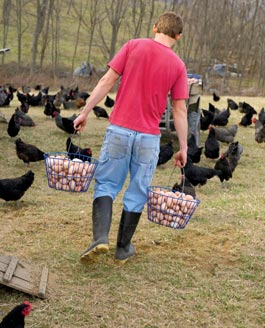
Photos: Jim Franco
I might never have found my way to Polyface Farm if Joel Salatin hadn’t refused to FedEx me one of his chickens.
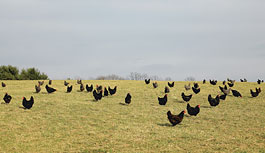
I’d heard a lot about the quality of the meat raised on his “beyond organic” farm, and was eager to sample some. Salatin and his family raise a half-dozen different species (grass-fed beef, chickens, pigs, turkeys, and rabbits) in an intricate rotation that has made his 550 hilly acres of pasture and woods in Virginia’s Shenandoah Valley one of the most productive and sustainable small farms in America. But when I telephoned Joel to ask him to send me a broiler, he said he couldn’t do that. I figured he meant he wasn’t set up for shipping, so I offered to have an overnight delivery service come pick it up.
“No, I don’t think you understand. I don’t believe it’s sustainable—‘organic,’ if you will—to FedEx meat all around the country,” Joel told me. “I’m afraid if you want to try one of our chickens, you’re going to have to drive down here to pick it up.”
This man was serious. He went on to explain that Polyface does not ship long distance, does not sell to supermarkets, and does not wholesale its food. All of the meat and eggs that Polyface produces is eaten within a few dozen miles or, at the most, half a day’s drive of the farm—within the farm’s “foodshed.” At first I assumed Joel’s motive for keeping his food chain so short was strictly environmental—to save on the prodigious quantities of fossil fuel Americans burn moving their food around the country and, increasingly today, the world. (The typical fruit or vegetable on an American’s plate travels some 1,500 miles to get there, and is frequently better traveled and more worldly than its eater.) But after taking Joel up on his offer to drive down to Swoope, Virginia, to pick up a chicken, I picked up a great deal more—about the renaissance of local food systems, and the values they support, values that go far beyond the ones a food buyer supports when he or she buys organic in the supermarket. It turns out that Joel Salatin, and the local food movement he’s become an influential part of, is out to save a whole lot more than energy.
In Joel’s view, the reformation of our food economy begins with people going to the trouble and expense of buying directly from farmers they know—“relationship marketing,” the approach he urges in his recent book, Holy Cows and Hog Heaven: The Food Buyer’s Guide to Farm Friendly Food. Joel believes that the only meaningful guarantee of integrity is when buyers and sellers can look one another in the eye, something few of us ever take the trouble to do. “Don’t you find it odd that people will put more work into choosing their mechanic or house contractor than they will into choosing the person who grows their food?”
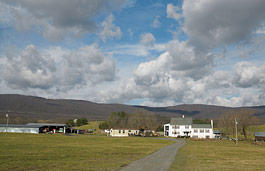
Joel Salatin’s Polyface Farm
Joel, who describes himself as a “Christian-libertarian-environmentalist-lunatic farmer,” speaks of his farming as his “ministry,” and certainly his 1,000 or so regular customers hear plenty of preaching. Each spring he sends out a long, feisty, single-spaced letter that could convince even a fast-food junkie that buying a pastured broiler from Polyface Farm qualifies as an act of social, environmental, nutritional, and political redemption.
“Greetings from the non-bar code people,” began one recent missive, before launching into a high-flying jeremiad against our disconnected “multi-national global corporate techno-glitzy food system” with its “industrial fecal factory concentration camp farms.” (The dangerous pileup of modifiers is a hallmark of Joel’s rhetorical style.) Like any good jeremiad, this one eventually transits from despair to hope, noting that the “yearning in the human soul to smell a flower, pet a pig and enjoy food with a face is stronger now than anytime in history,” before moving into a matter-of-fact discussion of this year’s prices and the paramount importance of sending in your order blanks and showing up to collect your chickens on time.
I met several of Polyface’s parishioners on a Thursday in June as they came to collect the fresh chickens they’d reserved. It was a remarkably diverse group of people: a schoolteacher, several retirees, a young mom with her towheaded twins, a mechanic, an opera singer, a furniture maker, a woman who worked in a metal fabrication plant in Staunton. They were paying a premium over supermarket prices for Polyface food, and in many cases driving more than an hour over a daunting (though gorgeous) tangle of county roads to come get it. But no one would ever mistake these people for the well-heeled, urban foodies generally thought to comprise the market for organic or artisanal food. There was plenty of polyester in this crowd and a lot more Chevrolets than Volvos in the parking lot.
So what exactly had they come all the way out here to the farm to buy? Here are some of the comments I collected:
“This is chicken as I remember it from my childhood. It actually tastes like chicken.”
“I just don’t trust the food in the supermarket anymore.”
“These eggs just jump up and slap you in the face!”
“You’re not going to find fresher chickens anywhere.”
“All this meat comes from happy animals—I know because I’ve seen them. And the pork tenderloin is to die for!”
“I drive 150 miles one way to get clean meat for my family.”
“It’s very simple: I trust the Salatins more than I trust Wal-Mart. And I like the idea of keeping my money right here in town.”
I was hearing, in other words, the same stew of food fears and food pleasures (and food memories) that has driven the growth of the organic food industry over the past 20 years—that, and the satisfaction many Polyface customers clearly take in spending a little time on a farm, porch-chatting with the Salatins, and taking a beautiful drive in the country to get here. For some people, reconnecting with the source of their food is a powerful idea. For the farmer, these on-farm sales allow him to recapture the 92 cents of a consumer’s food dollar that now typically winds up in the pockets of processors, middlemen, and retailers.
I asked Joel how he answers the charge that because food like his is more expensive, it is inherently elitist. “I don’t accept the premise,” he replied. “First off, those weren’t any ‘elitists’ you met on the farm this morning. We sell to all kinds of people. Second, whenever I hear people say clean food is expensive, I tell them it’s actually the cheapest food you can buy. That always gets their attention. Then I explain that, with our food, all of the costs are figured into the price. Society is not bearing the cost of water pollution, of antibiotic resistance, of food-borne illnesses, of crop subsidies, of subsidized oil and water—of all the hidden costs to the environment and the taxpayer that make cheap food seem cheap. No thinking person will tell you they don’t care about all that. I tell them the choice is simple: You can buy honestly priced food or you can buy irresponsibly priced food.”
As it is, artisanal producers like Joel compete on quality, which, oddly enough, is still a somewhat novel idea when it comes to food. “When someone drives up to the farm in a BMW and asks me why our eggs cost more, well, first I try not to get mad,” said Joel. “Frankly, any city person who doesn’t think I deserve a white-collar salary as a farmer doesn’t deserve my special food. Let them eat E. coli. But I don’t say that. Instead I take him outside and point at his car. ‘Sir, you clearly understand quality and are willing to pay for it. Well, food is no different: You get what you pay for.’
“Why is it that we exempt food, of all things, from that rule? Industrial agriculture, because it depends on standardization, has bombarded us with the message that all pork is pork, all chicken is chicken, eggs eggs, even though we all know that can’t really be true. But it’s downright un-American to suggest that one egg might be nutritionally superior to another.” Joel recited the slogan of his local supermarket chain: “‘We pile it high and sell it cheap.’ What other business would ever sell its products that way?”
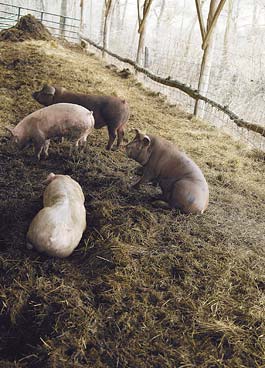
When you think about it, it is odd that something as important to our health and general well-being as food is so often sold strictly on the basis of price. Look at any supermarket ad in the newspaper and all you will find in it are quantities—pounds and dollars; qualities of any kind are nowhere to be found. The value of relationship marketing is that it allows many kinds of information besides price to travel up and down the food chain: stories as well as numbers, qualities as well as quantities, values rather than “value.” And as soon as that happens, people begin to make different kinds of buying decisions, motivated by criteria other than price. But instead of stories about how it was produced accompanying our food, we get bar codes—as illegible as the industrial food chain itself, and a fair symbol of its almost total opacity.
Much of our food system depends on our not knowing much about it, beyond the price disclosed by the checkout scanner; cheapness and ignorance are mutually reinforcing. And it’s a short way from not knowing who’s at the other end of your food chain to not caring—to the carelessness of both producers and consumers that characterizes our economy today. Of course, the global economy couldn’t very well function without this wall of ignorance and the indifference it breeds. This is why the American food industry and its international counterparts fight to keep their products from telling even the simplest stories—“dolphin safe,” “humanely slaughtered,” etc.—about how they were produced. The more knowledge people have about the way their food is produced, the more likely it is that their values—and not just “value”—will inform their purchasing decisions.
TO TALK TO THE CUSTOMERS and farmers working together in Joel Salatin’s corner of the country to rebuild a local food chain is to appreciate it is a movement and not merely a market. Or rather it is a novel hybrid, a market-as-movement for at its heart is a new conception of what it means to be a “consumer”—an attempt to redeem that ugly word, with its dismal colorings of selfishness and subtraction. Many of the Polyface customers I met (though by no means all of them) had come to see their decision to buy a chicken from a local farmer rather than from Wal-Mart as a kind of civic act, even a form of protest. A protest of what exactly is harder to pin down, and each person might put it a little differently, but the customers I met at Polyface had gone to some trouble and expense to “opt out”—of the supermarket, of the fast-food nation, and, standing behind that, a globalized industrial agriculture. Their talk of distrusting Wal-Mart, resenting the abuse of animals in farm factories, insisting on knowing who was growing their food, and wanting to keep their food dollars in town—all this suggested that for many of these people spending a little more for a dozen eggs was a decision inflected by a politics, however tentative or inchoate.
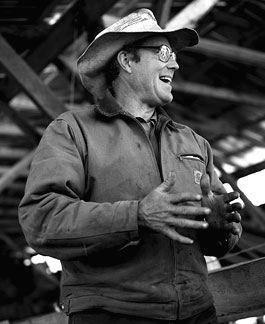
“Beyond organic” farmer Joel Salatin
“Opting out” is a key term for Joel, who believes that it would be a fatal mistake to “try to sell a connected, holistic, ensouled product through a Western, reductionist, Wall Street sales scheme”—by which (I think) he means selling to big organic supermarkets like Whole Foods. As far as Joel is concerned, there isn’t a world of difference between Whole Foods and Wal-Mart. Both are part of an increasingly globalized economy that turns any food it touches into a commodity, reaching its tentacles wherever in the world a food can be produced most cheaply and then transporting it wherever it can be sold most dearly.
Shortly before I traveled to Virginia, I’d reread an essay by Wendell Berry in which he argued that reversing the damage done to local economies and the land by the juggernaut of world trade would take nothing less than “a revolt of local small producers and local consumers against the global industrialism of the corporations.” He detected the beginnings of such a rebellion in the rise of local food systems and the growing market “for good, fresh, trustworthy food, food from producers known and trusted by consumers.” Which, as he points out, “cannot be produced by a global corporation.” Berry would have me believe that what I was seeing in the Polyface salesroom represented a local uprising in a gathering worldwide rebellion against what he calls “the total economy.”
Why should food, of all things, be the linchpin of that rebellion? Perhaps because food is a powerful metaphor for a great many of the values to which people feel globalization poses a threat, including the distinctiveness of local cultures and identities, the survival of local landscapes, and biodiversity. When José Bové, the French Roquefort farmer and anti-globalization activist, wanted to make his stand against globalization, he used his tractor to smash not a bank or insurance company but a McDonald’s. Indeed, the most powerful protests against globalization to date have revolved around food: I’m thinking of the movement against genetically modified crops, the campaign against patented seeds in India (which a few years ago brought as many as half a million Indians into the streets to protest World Trade Organization intellectual property rules), and Slow Food, the Italian-born international move- ment that seeks to defend traditional food cultures against the global tide of homogenization.
Even for people who find the logic of globalization otherwise compelling, the globalization of food often stops them short. Treating food as a commodity like any other simply doesn’t square with their beliefs or experience. But that is precisely where the logic of globalization leads: Once the last barrier to free trade comes down, and the last program of government support for farmers ends, our food will come from wherever in the world it can be produced most cheaply. The iron law of competitive advantage dictates that if another country can grow something more efficiently—whether because its land or labor is cheaper or its environmental laws more lax—we will no longer grow it here. What’s more, under the global economic dispensation, this is an outcome to be wished for, since it will free our land for more productive uses—more houses, say. Since land in the United States is relatively expensive, and our tolerance for agricultural pollution and animal cruelty is rapidly wearing thin, in the future all our food may come from elsewhere, as well it should. This argument has been made by, among others, economist Steven C. Blank, in a book rather bloodlessly titled The End of Agriculture in the American Portfolio.
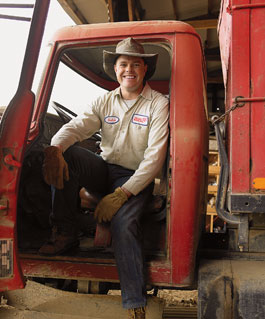
Joel Salatin’s son Daniel
And why should a nation produce its own food when others can produce it more cheaply? A dozen reasons leap to mind, but most of them the Steven Blanks of the world—and they are legion—are quick to dismiss as sentimental. I’m thinking of the sense of security that comes from knowing your community, or country, can feed itself; the beauty of an agricultural landscape; the outlook and kinds of local knowledge the presence of farmers brings to a community; the satisfactions of buying food from a farmer you know rather than the supermarket; the locally inflected flavor of a raw-milk cheese or honey. All those things—all those pastoral values—free trade pro-poses to sacrifice in the name of efficiency and economic growth.
Though you do begin to wonder who is truly the “realist” in this debate, and who the romantic. We live, as Berry has written, in an era of “sentimental economics,” since the promise of global capitalism, much like the promise of communism before it, ultimately depends on an act of faith: that if we permit the destruction of certain things we value here and now, we will achieve a greater happiness and prosperity at some unspecified future date. As Lenin reputedly put it, in a sentiment the WTO endorses in its rulings every day, you have to break a few eggs to make an omelet.
Perhaps it is no accident that sentimental communism foundered precisely on the issue of food. The Soviets sacrificed millions of small farms and farmers to the dream of a collectivized industrial agriculture that never managed to do what a food system has to do: feed the nation. By the time of its collapse, more than half of the food consumed in the Soviet Union was being produced by small farmers and home gardeners operating without official sanction on private plots tucked away in the overlooked corners and cracks of the crumbling Soviet monolith. George Naylor, an outspoken Iowa corn and soybean farmer who heads up the National Family Farm Coalition, has likened the rise of alternative food chains in America to “the last days of Soviet agriculture. The centralized food system wasn’t serving the people’s needs, so they went around it. The rise of farmer’s markets and CSAs [community supported agriculture, the name for farms that offer weekly boxes of produce on a subscription basis] is sending the same signal today.” Of course, the problems of our food system are very different—if anything, it produces too much food, not too little, or too much of the wrong food. But there’s no question that it is failing many consumers and producers, who together are finding creative ways around it.
So much about life in a global economy feels as though it has passed beyond the individual’s control—what happens to our jobs, to the prices at the gas station, to the votes in the legislature. But somehow food still feels a little different. We can still decide, every day, what we’re going to put into our bodies, what sort of food chain we want to participate in. We can, in other words, reject the industrial omelet on offer and decide to eat another. This might not sound like a big deal, but it could be the beginnings of one. Already the desire on the part of consumers to put something different in their bodies has created a $14 billion market in organic food in the United States. That marketplace was built by consumers and farmers working informally together outside the system, with exactly no help from the government.
The total economy, astounding in its ability to absorb every challenge, is well on its way to transforming organic food from a reform movement into an industry—another flavor in the global supermarket. It took capitalism less than a quarter century to turn even something as ephemeral as bagged salads of cut and washed organic mesclun, of all things, into a cheap international commodity retailed in a new organic supermarket. Whether this is a good or bad thing, people will disagree; probably it’s a little of both.
Joel Salatin and his customers want to be somewhere that juggernaut can’t go, and it may be that by elevating local above organic, they have found exactly that place. By definition, local is a hard thing to sell in a global marketplace. Local food, as opposed to organic, implies a new economy as well as a new agriculture—new social and economic relationships as well as new ecological ones. It’s a lot more complicated.
Of course, just because food is local doesn’t necessarily mean it will be organic or even sustainable. There’s nothing to stop a local farm from using chemicals or abusing animals—except the gaze or good word of its customers. Instead of looking at labels, the local food customer will look at the farm for himself, or look the farmer in the eye and ask him about how he grows his crops or treats his animals. That said, there are good reasons to think a genuinely local agriculture will tend to be a more sustainable agriculture. For one thing, it is much less likely to rely on monoculture, the original sin from which almost every other problem of our food system flows. A farmer dependent on a local market will, perforce, need to grow a wide variety of things, rather than specialize in the one or two plants or animals that the national market (organic or otherwise) would ask from him.
The supermarket wants all its lettuce from the Central Valley, all its apples from Washington state, and all its corn from Iowa. (At least until the day it decides it wants all its corn from Argentina, all its apples from China, and all its lettuce from Mexico.) People in Iowa can eat only so much corn and soybeans themselves. So when Iowans decide to eat locally, rather than from the supermarket, their farmers will quickly learn to grow a few other things besides. And when they do, they’ll probably find they can give up most of their fertilizers and pesticides, since a diversified farm will produce much of its own fertility and its own pest control.
Shopping in the Organic Supermarket underwrites important values on the farm; shopping locally underwrites a whole set of other values as well. Farms produce a lot more than food; they also produce a kind of landscape and kind of community. Whether Polyface’s customers spend their food dollars here in Swoope or in the Whole Foods in Charlottesville will have a large bearing on whether this lovely valley—this undulating checkerboard of fields and forests—will endure, or whether the total economy will find a “higher use” for it. “Eat your view!” is a bumper sticker often seen in Europe these days; as it implies, the decision to eat locally is an act of land conservation as well, one that is probably a lot more effective (and sustainable) than writing checks to environmental organizations.
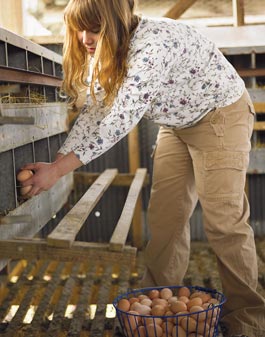
Joel Salatin’s niece Heidi
“Eat your view!” takes work, however. To participate in a local food economy requires considerably more effort than shopping at the Whole Foods. You won’t find anything microwavable at the farmer’s market or in your weekly box of organic produce from the CSA, and you won’t find a tomato in December. The local food shopper will need to put some work into sourcing his own food—learning who grows the best lamb in his area, or the best sweet corn. And then he will have to become reacquainted with his kitchen. Much of the appeal of the industrial food chain is its convenience; it offers busy people a way to delegate their cooking (and food preservation) to others. At the other end of the industrial food chain that begins in a cornfield in Iowa sits an industrial eater at a table. (Or, increasingly, in a car.) The achievement of the industrial food system over the past half-century has been to transform most of us into precisely that creature.
All of which is to say that a successful local food economy implies not only a new kind of food producer but a new kind of eater —one who regards finding, preparing, and preserving food as one of the pleasures of life rather than a chore. One whose sense of taste has ruined him for a Big Mac, and whose sense of place has ruined him for shopping for groceries at Wal-Mart. This is the consumer who understands—or remembers—that, in Wendell Berry’s memorable phrase, “eating is an agricultural act.” He might have added it’s a political act as well.
ON MY LAST DAY ON THE FARM, a soft June Friday afternoon, Joel and I sat talking at a picnic table behind the house while a steady stream of customers dropped by to pick up their chickens. I asked him if he believed the industrial food chain would ever be overturned by an informal, improvised movement made up of farmer’s markets, box schemes, metropolitan buying clubs, Slow Foodies, and artisanal meat-processing plants. Even if you count the Organic Supermarket, the entire market for all alternative foods remains but a flea on the colossus of the industrial food economy, with its numberless fast-food outlets and supermarkets backed by infinite horizons of corn and soybeans.
“We don’t have to beat them,” Joel patiently explained. “I’m not even sure we should try. We don’t need a law against McDonald’s or a law against slaughterhouse abuse—we ask for too much salvation by legislation. All we need to do is empower individuals with the right philosophy and the right information to opt out en masse.
“And make no mistake: it’s happening. The mainstream is splitting into smaller and smaller groups of like-minded people. It’s a little like Luther nailing his 95 theses up at Wittenberg. Back then it was the printing press that allowed the Protestants to break off and form their own communities; now it’s the Internet, splintering us into tribes that want to go their own way.”
Of course! Joel saw himself as more of a Luther than a Lenin; the goal wasn’t to blow up the Church but simply to step around it. Protestantism also comes in many denominations, as I suspect will the future of food. Deciding whether that future should more closely resemble Joel’s radically local vision or Whole Foods’ industrial organic matters less than assuring that thriving alternatives exist; feeding the cities may require a different sort of food chain than feeding the countryside. We may need a great many different alternative food chains, organic and local, biodynamic and Slow, and others yet undreamed of. As in the fields, nature may provide the best model for the marketplace, and nature never puts all her eggs in one basket. The great virtue of a diversified food economy, like a diverse pasture or farm, is its ability to withstand any shock. The important thing is that there be many food chains, so that when any one of them fails—when the oil runs out, when mad cow or other food-borne diseases become epidemic, when the pesticides no longer work, when drought strikes and plagues come and soils blow away—we’ll still have a way to feed ourselves. It is because some of those failures are already in view that the salesroom at Polyface Farm is buzzing with activity this afternoon, and why farmer’s markets in towns and cities all across America are buzzing this afternoon too.
“An alternative food system is rising up on the margins,” Joel continued. “One day Frank Perdue and Don Tyson are going to wake up and find that their world has changed. It won’t happen overnight, but it will happen, just as it did for those Catholic priests who came to church one Sunday morning only to find that, my goodness, there aren’t as many people in the pews today. Where in the world has everybody gone?”